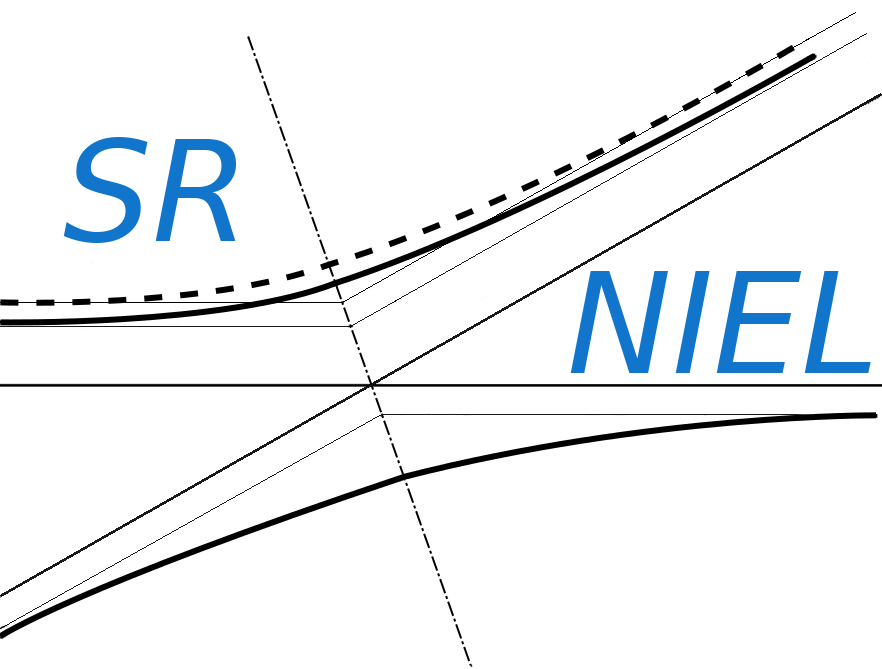



The SR-NIEL table generator is derived from the electrons, protons and ions NIEL calculators. The energy range is fixed from 0.1 keV to 10 GeV. If the hadronic contribution is selected, the table is generated only if fully available, up to a maximum energy of 1 GeV/nucleon with No threshold-energy scaling applied to the hadronic contribution.
NOTE:
- Experimentally determined Ed values are:
- Ga: 21.5 eV, As: 21.5 eV as reported in [Campesato et al. (2019)] from proton, electron and neutron irradiations of solar cells. In Triple Junction solar cells, in which the dominant damage mechanism is that due to the GaAs middle junction, a commonly effective value of Ed was 24 eV [Campesato et al. (2018), Campesato et al. (2019)].
- Ge: 40.5 eV as reported in [Campesato et al. (2019)].
- In: 43 eV, Ga: 21 eV, P: 21 eV as reported in [Campesato et al. (2018)] for In0.49Ga0.51P single junction solar cells irradiated with electrons and protons. In [Campesato et al. (2019)] with electron, proton and neutron irradiation, it was shown that a commonly effective value of Ed = 38 eV can be employed in an equivalent way.
- In the present NIEL calculators, for protons up to 1 GeV and alpha-particles up to 1 GeV/nucleon impinging on elements with atomic number from Z=4 up to Z=51, the hadronic contributions were interpolated or extrapolated from those obtained from [Jun et al. (2003, 2004), Jun (2017)] regarding 10 absorbers (i.e., C, Al, Si, P, Ga, Ge, As, In, Cu, Se). For silicon absorbers, in addition, the hadronic contribution for energies from 1 up to 24 GeV was obtained from [Huhtinen (2002)].
- In the present treatment for electrons, screening effects are factorized in the expression for the differential cross section (Boschini et al. (2011)). However, it has to be remarked - as derived by Zeitler and Olsen (1956) - that for electron energies above 200 keV the overlap of spin and screening effects is small for all elements and for all energies; for lower energies the overlapping of the spin and screening effects may be appreciable for heavy elements and large angles.
- User can suggest an "ad hoc" form factor by contacting us using
This email address is being protected from spambots. You need JavaScript enabled to view it. . In fact (see discussion in Boschini et al. (2011)), a further work is likely to be needed for the most suited parametrization of the nuclear form factor, particularly for high-Z material. - NIEL for compounds can be determined by means of Bragg's rule, i.e., the overall NIEL in units of MeV cm2/g is obtained as a weighted sum in which each material contributes proportionally to the fraction of its atomic weight.